What is mealy and moore machine and their functioning?

What is Moore and Mealy Machines?

Finite automata generate outputs related to each act. While two types of finite state machines creates output −

  • Mealy Machine
  • Moore machine

Mealy Machine

A Mealy Machine is considered as an FSM, the output will be based on the present state and the present input.

Mealy machine is explained as a 6 tuple (Q, ∑, O, δ, X, q0) where −

  • Q is a finite set of states.
  • ∑ is a finite set of symbols called the input alphabet.
  • O is a finite set of symbols called the output alphabet.
  • δ is the input transition function where δ: Q × ∑ → Q
  • X is the output transition function where X: Q × ∑ → O
  • q0 is the initial state from where any input is processed (q0 ∈ Q).

The state table of a Mealy Machine is mentioned below −

Present state Next state
input = 0 input = 1
State Output State Output
→ a b x1 c x1
b b x2 d x3
c d x3 c x1
d d x3 d x2

The state diagram of the above Mealy Machine is −

state_diagram_of_mealy_machine

Moore Machine

Moore machine is also considered as an FSM and the outputs depend on the present state.

A Moore machine is also explained by a 6 tuple (Q, ∑, O, δ, X, q0) where −

  • Q is a finite set of states.
  • ∑ is a finite set of symbols called the input alphabet.
  • O is a finite set of symbols called the output alphabet.
  • δ is the input transition function where δ: Q × ∑ → Q
  • X is the output transition function where X: Q → O
  • q0 is the initial state from where any input is processed (q0 ∈ Q).

The state table of a Moore Machine is shown below −

Present state Next State Output
Input = 0 Input = 1
→ a b c x2
b b d x1
c c d x2
d d d x3

The state diagram of the above Moore Machine is −

moore_machine_state_diagram

Mealy Machine vs. Moore Machine

Let’s see the below table which highlights the points that creates a difference between a Mealy Machine and Moore Machine.

Mealy Machine Moore Machine
Output depends both upon present state and present input. Output depends only upon the present state.
Generally, it has fewer states than Moore Machine. Generally, it has more states than Mealy Machine.
Output changes at the clock edges. Input change can cause change in output change as soon as logic is done.
Mealy machines react faster to inputs In Moore machines, more logic is needed to decode the outputs since it has more circuit delays.

Mealy MachineMoore Machine

Output depends both upon present state and present input.Output depends only upon the present state.

Generally, it has fewer states than Moore Machine.Generally, it has more states than Mealy Machine.

Output changes at the clock edges.Input change can cause change in output change as soon as logic is done.

Mealy machines react faster to inputsIn Moore machines, more logic is needed to decode the outputs since it has more circuit delays.

Moore Machine to Mealy Machine

Algorithm 4

Input − Moore Machine

Output − Mealy Machine

Step 1 − Take a blank Mealy Machine transition table format.

Step 2 − Copy all the Moore Machine transition states into this table format.

Step 3 – Now check the present states and their corresponding outputs in the Moore Machine state table; if for a state Qi output is m, copy it into the output columns of the Mealy Machine state table wherever Qi appears in the next state.

Example

Let’s see the following Moore machine −

Present State Next State Output
a = 0 a = 1
→ a d b 1
b a d 0
c c c 0
d b a 1

Now we apply Algorithm 4 to convert it to Mealy Machine.

Step 1 & 2 −

Present State Next State
a = 0 a = 1
State Output State Output
→ a d b
b a d
c c c
d b a

Step 3 

Present State Next State
a = 0 a = 1
State Output State Output
=> a d 1 b 0
b a 1 d 1
c c 0 c 0
d b 0 a 1

Mealy Machine to Moore Machine

Algorithm 5

Input − Mealy Machine

Output − Moore Machine

Step 1 – Here measure the number of different outputs for each state (Qi) that are available in the state table of the Mealy machine.

Step 2 – Incase if all the outputs of Qi are same, copy state Qi. If it has n distinct outputs, break Qi into n states as Qin where n = 0, 1, 2…….

Step 3 − If the output of the initial state is 1, insert a new initial state at the beginning which gives 0 output.

Example

Let’s see the following Mealy Machine −

Present State Next State
a = 0 a = 1
Next State Output Next State Output
→ a d 0 b 1
b a 1 d 0
c c 1 c 0
d b 0 a 1

While the states ‘a’ and ‘d’ provide only 1 and 0 outputs respectively, so we creates states ‘a’ and ‘d’. But states ‘b’ and ‘c’ delivers different outputs (1 and 0). So, we divide b into b0, b1 and cinto c0, c1.

Present State Next State Output
a = 0 a = 1
→ a d b1 1
b0 a d 0
b1 a d 1
c0 c1 C0 0
c1 c1 C0 1
d b0 a 0

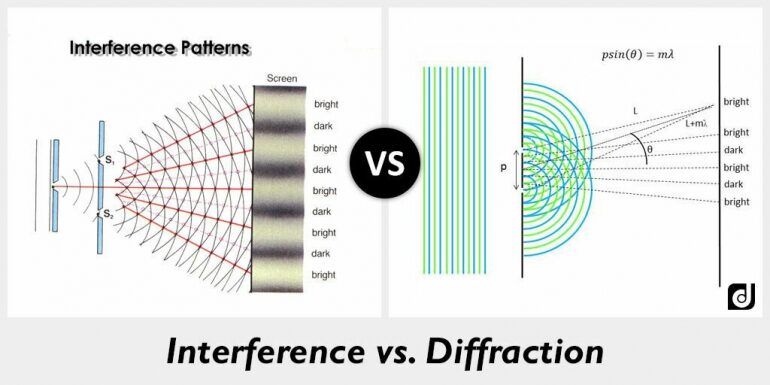
What is the difference between Interference and Diffraction?

  • interferenceAn effect caused by the superposition of two systems of waves, such as a distortion on a broadcast signal due to atmospheric or other effects. In physics, interference is a phenomenon in which two waves superimpose to form a resultant wave of greater or lower amplitude.
  • amplitudeThe maximum absolute value of some quantity that varies, especially a wave.
  • diffractionThe breaking up of an electromagnetic wave as it passes a geometric structure (e.g., a slit), followed by reconstruction of the wave by interference.

In physics, interference is a phenomenon in which two waves superimpose to form a resultant wave of greater or lower amplitude. Interference usually refers to the interaction of waves that are correlated or coherent with each other, either because they come from the same source or because they have the same (or nearly the same) frequency. Interference effects can be observed with all types of waves, including light, radio, acoustic, and surface water waves. In chemistry, the applications of interference to light are the most relevant to the study of matter.

Mechanism of Interference

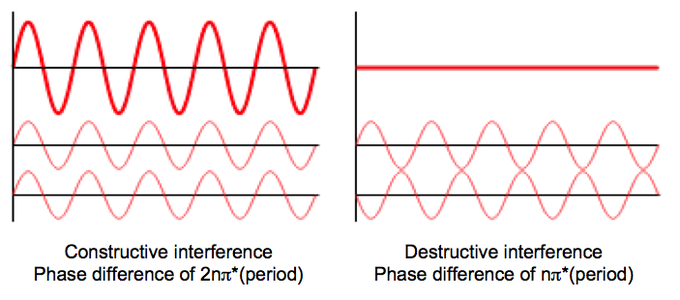
The principle of superposition of waves states that when two or more waves are incident on the same point, the total displacement at that point is equal to the vector sum of the displacements of the individual waves. If a crest of a wave meets a crest of another wave of the same frequency at the same point, then the magnitude of the displacement is the sum of the individual magnitudes; this is known as constructive interference. If a crest of one wave meets a trough of another wave, then the magnitude of the displacements is equal to the difference in the individual magnitudes; this is known as destructive interference.

Interference of two wavesThese two examples represent constructive (left) and destructive interference (right) in wave phenomena. When the two waves are “in phase,” their periods are offset by 2nπ*period. However, when they are precisely out of phase, destructive interference results if the phase difference is nπ*period.

Constructive interference occurs when the phase difference between the waves is a multiple of 2π, whereas destructive interference occurs when the difference is π, 3π, 5π, etc. If the difference between the phases is intermediate between these two extremes, then the magnitude of the displacement of the summed waves lies between the minimum and maximum values.

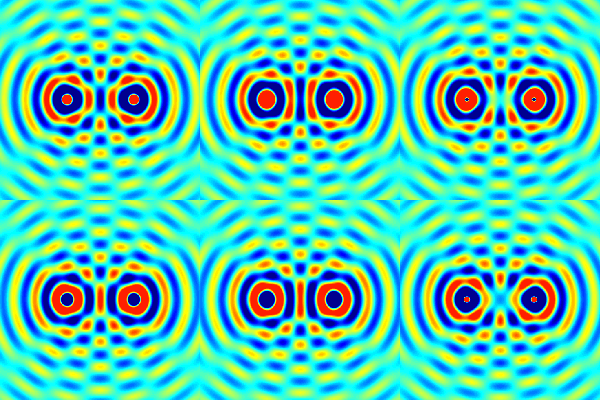
Consider, for example, what happens when two identical stones are dropped into a still pool of water at different locations. Each stone generates a circular wave propagating outwards from the point where the stone was dropped. When the two waves overlap, the net displacement at a particular point is the sum of the displacements of the individual waves. At some points, these will be in phase and will produce a maximum displacement. In other places, the waves will be in anti-phase and there will be no net displacement at these points. Thus, parts of the surface will be stationary.

Two Sources of InterferenceThe effect of two waves interfering with each other, for example, two stones thrown into a pool of water.

Diffraction

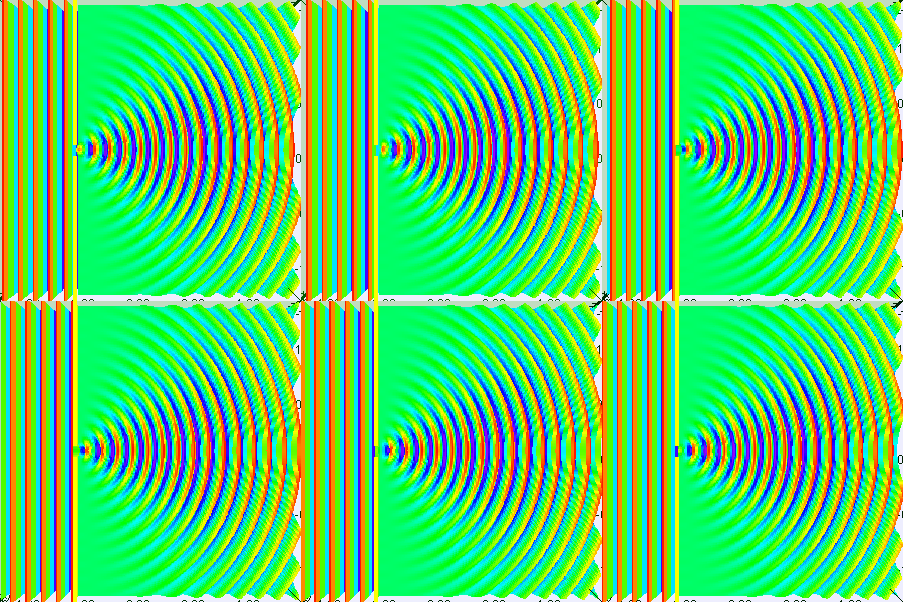
Diffraction refers to various phenomena that occur when a wave encounters an obstacle. In classical physics, the diffraction phenomenon is described as the apparent bending of waves around small obstacles and the spreading out of waves past small openings. Similar effects occur when light waves travel through a medium with a varying refractive index or a sound wave through one with varying acoustic impedance. Diffraction occurs with all waves, including sound waves, water waves, and electromagnetic waves such as visible light, X-rays, and radio waves. As physical objects have wave-like properties (at the atomic level), diffraction also occurs with matter and can be studied according to the principles of quantum mechanics. Italian scientist Francesco Maria Grimaldi coined the word diffraction and was the first to record accurate observations of the phenomenon in 1665.

DiffractionIn classical physics, the diffraction phenomenon is described as the apparent bending of waves around small obstacles and the spreading out of waves past small openings.

The effects of diffraction are often seen in everyday life. The most striking examples of diffraction are those involving light; for example, the closely spaced tracks on a CD or DVD act as a diffraction grating to form the familiar rainbow pattern seen when looking at a disk.

  • interferenceAn effect caused by the superposition of two systems of waves, such as a distortion on a broadcast signal due to atmospheric or other effects. In physics, interference is a phenomenon in which two waves superimpose to form a resultant wave of greater or lower amplitude.
  • amplitudeThe maximum absolute value of some quantity that varies, especially a wave.
  • diffractionThe breaking up of an electromagnetic wave as it passes a geometric structure (e.g., a slit), followed by reconstruction of the wave by interference.

In physics, interference is a phenomenon in which two waves superimpose to form a resultant wave of greater or lower amplitude. Interference usually refers to the interaction of waves that are correlated or coherent with each other, either because they come from the same source or because they have the same (or nearly the same) frequency. Interference effects can be observed with all types of waves, including light, radio, acoustic, and surface water waves. In chemistry, the applications of interference to light are the most relevant to the study of matter.

Mechanism of Interference

The principle of superposition of waves states that when two or more waves are incident on the same point, the total displacement at that point is equal to the vector sum of the displacements of the individual waves. If a crest of a wave meets a crest of another wave of the same frequency at the same point, then the magnitude of the displacement is the sum of the individual magnitudes; this is known as constructive interference. If a crest of one wave meets a trough of another wave, then the magnitude of the displacements is equal to the difference in the individual magnitudes; this is known as destructive interference.

Interference of two wavesThese two examples represent constructive (left) and destructive interference (right) in wave phenomena. When the two waves are “in phase,” their periods are offset by 2nπ*period. However, when they are precisely out of phase, destructive interference results if the phase difference is nπ*period.

Constructive interference occurs when the phase difference between the waves is a multiple of 2π, whereas destructive interference occurs when the difference is π, 3π, 5π, etc. If the difference between the phases is intermediate between these two extremes, then the magnitude of the displacement of the summed waves lies between the minimum and maximum values.

Consider, for example, what happens when two identical stones are dropped into a still pool of water at different locations. Each stone generates a circular wave propagating outwards from the point where the stone was dropped. When the two waves overlap, the net displacement at a particular point is the sum of the displacements of the individual waves. At some points, these will be in phase and will produce a maximum displacement. In other places, the waves will be in anti-phase and there will be no net displacement at these points. Thus, parts of the surface will be stationary.

Two Sources of InterferenceThe effect of two waves interfering with each other, for example, two stones thrown into a pool of water.

Diffraction

Diffraction refers to various phenomena that occur when a wave encounters an obstacle. In classical physics, the diffraction phenomenon is described as the apparent bending of waves around small obstacles and the spreading out of waves past small openings. Similar effects occur when light waves travel through a medium with a varying refractive index or a sound wave through one with varying acoustic impedance. Diffraction occurs with all waves, including sound waves, water waves, and electromagnetic waves such as visible light, X-rays, and radio waves. As physical objects have wave-like properties (at the atomic level), diffraction also occurs with matter and can be studied according to the principles of quantum mechanics. Italian scientist Francesco Maria Grimaldi coined the word diffraction and was the first to record accurate observations of the phenomenon in 1665.

DiffractionIn classical physics, the diffraction phenomenon is described as the apparent bending of waves around small obstacles and the spreading out of waves past small openings.

The effects of diffraction are often seen in everyday life. The most striking examples of diffraction are those involving light; for example, the closely spaced tracks on a CD or DVD act as a diffraction grating to form the familiar rainbow pattern seen when looking at a disk.

  • interferenceAn effect caused by the superposition of two systems of waves, such as a distortion on a broadcast signal due to atmospheric or other effects. In physics, interference is a phenomenon in which two waves superimpose to form a resultant wave of greater or lower amplitude.
  • amplitudeThe maximum absolute value of some quantity that varies, especially a wave.
  • diffractionThe breaking up of an electromagnetic wave as it passes a geometric structure (e.g., a slit), followed by reconstruction of the wave by interference.

In physics, interference is a phenomenon in which two waves superimpose to form a resultant wave of greater or lower amplitude. Interference usually refers to the interaction of waves that are correlated or coherent with each other, either because they come from the same source or because they have the same (or nearly the same) frequency. Interference effects can be observed with all types of waves, including light, radio, acoustic, and surface water waves. In chemistry, the applications of interference to light are the most relevant to the study of matter.

Mechanism of Interference

The principle of superposition of waves states that when two or more waves are incident on the same point, the total displacement at that point is equal to the vector sum of the displacements of the individual waves. If a crest of a wave meets a crest of another wave of the same frequency at the same point, then the magnitude of the displacement is the sum of the individual magnitudes; this is known as constructive interference. If a crest of one wave meets a trough of another wave, then the magnitude of the displacements is equal to the difference in the individual magnitudes; this is known as destructive interference.

Interference of two wavesThese two examples represent constructive (left) and destructive interference (right) in wave phenomena. When the two waves are “in phase,” their periods are offset by 2nπ*period. However, when they are precisely out of phase, destructive interference results if the phase difference is nπ*period.

Constructive interference occurs when the phase difference between the waves is a multiple of 2π, whereas destructive interference occurs when the difference is π, 3π, 5π, etc. If the difference between the phases is intermediate between these two extremes, then the magnitude of the displacement of the summed waves lies between the minimum and maximum values.

Consider, for example, what happens when two identical stones are dropped into a still pool of water at different locations. Each stone generates a circular wave propagating outwards from the point where the stone was dropped. When the two waves overlap, the net displacement at a particular point is the sum of the displacements of the individual waves. At some points, these will be in phase and will produce a maximum displacement. In other places, the waves will be in anti-phase and there will be no net displacement at these points. Thus, parts of the surface will be stationary.

Two Sources of InterferenceThe effect of two waves interfering with each other, for example, two stones thrown into a pool of water.

Diffraction

Diffraction refers to various phenomena that occur when a wave encounters an obstacle. In classical physics, the diffraction phenomenon is described as the apparent bending of waves around small obstacles and the spreading out of waves past small openings. Similar effects occur when light waves travel through a medium with a varying refractive index or a sound wave through one with varying acoustic impedance. Diffraction occurs with all waves, including sound waves, water waves, and electromagnetic waves such as visible light, X-rays, and radio waves. As physical objects have wave-like properties (at the atomic level), diffraction also occurs with matter and can be studied according to the principles of quantum mechanics. Italian scientist Francesco Maria Grimaldi coined the word diffraction and was the first to record accurate observations of the phenomenon in 1665.

DiffractionIn classical physics, the diffraction phenomenon is described as the apparent bending of waves around small obstacles and the spreading out of waves past small openings.

The effects of diffraction are often seen in everyday life. The most striking examples of diffraction are those involving light; for example, the closely spaced tracks on a CD or DVD act as a diffraction grating to form the familiar rainbow pattern seen when looking at a disk.

Factor Affecting Entrepreneurship

Entrepreneurship is a complex phenomenon influenced by the interplay of a wide variety of factors. The entrepreneurial activity at any time is dependent upon a complex and varying combination of economic, social, political, psychological and other factors. These factors may have been both positive and negative effluences on the emergence of entrepreneurship. Positive influences constitute facilitative and conductive conclusive for the emergence of entrepreneurship whereas negative influences create inhibiting milieu to the emergence of entrepreneurship. Following factors contribute to the success of entrepreneurship:

1.Personality Factorsfactors_effecting_entrepreneurship :Personality traits such as inner desire for control of their activities, tolerance for risk, high level of tolerance to function in adverse situations and background experiences such as the family environment, level of education, age and work history tolerance for ambiguity are important personal characteristics that affect entrepreneurship. Individuals who are desirous of working independently; willing to work for long hours and assume risk; are self-confident and hard-working are likely to be more successful as entrepreneurs than those who do not posses these qualities

Personal factors, becoming core competencies of entrepreneurs, include:

(a) Initiative (does things before being asked for)

(b) Proactive (identification and utilization of opportunities)

(c) Perseverance (working against all odds to overcome obstacles and never complacent with success)

(d) Problem-solver (conceives new ideas and achieves innovative solutions)

(e) Persuasion (to customers and financiers for patronization of his business and develops & maintains relationships)

(f) Self-confidence (takes and sticks to his decisions)

(g) Self-critical (learning from his mistakes and experiences of others)

(h) A Planner (collects information, prepares a plan, and monitors performance)

(i) Risk-taker (the basic quality).

2. Environmental factors
These factors relate to the conditions in which an entrepreneur has to work. If the environment that a individual is working in is unsatisfactory, that is, not conducive to his growth needs, it is likely that the individual will quit his job and start his own business as an entrepreneur. Unsatisfied personal needs for growth and achievement in employment conditions results in successful entrepreneurship.

3. Political

Some researchers felt that the growth of entrepreneurship cannot be explained fully unless the political set-up of a country is taken into consideration. Political stability in a country is absolutely essential for smooth economic activity. Frequent political protests, strikes, etc. hinder economic activity and entrepreneurship. Unfair trade practices, irrational monetary and fiscal policies, etc. are a roadblock to the growth of entrepreneurship

4. Socio-Economic Factors

The entrepreneurial activity at any time and place is governed by varying combination of socio-economic factors. The empirical studies have identified the following socio economic factors:

Cast/religion
Family background
Level of Education
Level of perception
Legitimacy of Entrepreneurship
Migratory character
Social Mobility
Social Security
Investment capacity
Ambition/motivation
5. Economic Factor

Factors such as availability of finance, labor, land, accessibility of customers, suppliers are the factors that stimulate entrepreneurship. Capital is one of the most important prerequisites to establish an enterprise. Availability of sufficient capital affects the introduction, survival and growth of a business enterprise. Capital is regarded as lubricant to the process of production. If we increase in capital investment, capital output ratio also tends to increases. This results in increase in profit, which ultimately goes to capital formation. Due to this capital supply increase, entrepreneurship also increases.

6. Other Factors

Entrepreneurial Education
More and more people with high academic attainments started joining the ranks of industrialists, especially the professionals holding qualifications in engineering, law, medicine, cost and chartered accounting. The newer entrepreneurs have a larger proportion of their floatation in the traditional sector, but these professionals have by and large preferred to make their investments in modern sector. The technicians in particular among both old and new entrepreneurs have entered industries in the modern sector having a bearing of their academic qualifications. Many universities and institutes are nowadays offering entrepreneurship education. A number of institutes have set up successful entrepreneurship centers, which provide help to budding entrepreneurs by conducting formal training and structured mentoring programs.